
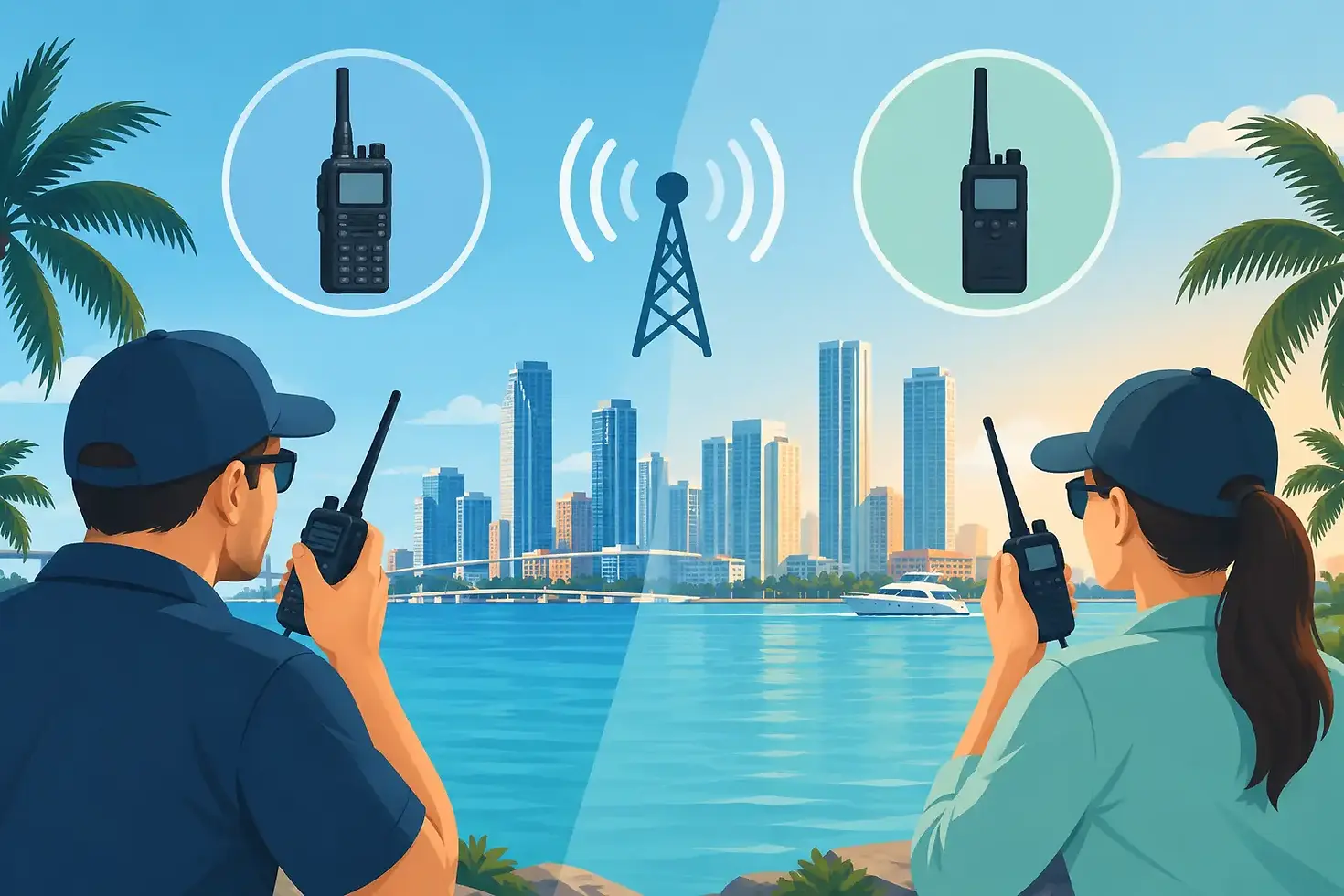
Ham Nets vs GMRS Nets for Miami Operators

A scheduled net is more than a time slot on a repeater. It is where operators test coverage, practice disciplined on-air procedures, exchange local conditions, and learn who is active nearby. The practical difference in ham nets vs GMRS nets starts with the rules behind each service, but it becomes most visible in the way a net is organized and who it is designed to serve.
For Miami-area operators, both can support local coordination before, during, and after severe weather, public events, or routine community activity. Neither service is automatically better. The right net depends on your license, your operating goals, the repeater available, and whether you want a technical amateur-radio forum, a family-ready communications group, or both.
Ham Nets vs GMRS Nets: The Operating Difference
Amateur radio nets operate under the Amateur Radio Service. Every transmitting participant must hold an amateur license appropriate to the privileges used. That shared licensing baseline often shapes the conversation. A ham net may include check-ins, technical discussion, propagation reports, directed traffic, training exercises, digital-mode coordination, and formal emergency communications practice.
GMRS nets operate under the General Mobile Radio Service. A GMRS license is issued to an individual, and eligible immediate family members may operate under that license. That family-use structure is one reason GMRS is attractive to preparedness-minded households, off-road groups, neighborhood teams, and people who want practical local communications without each active operator earning an amateur license.
On the air, both types of nets commonly use a repeater, a net control station, a check-in period, and a clear purpose. The distinction is not that ham nets are formal while GMRS nets are casual. Either can be tightly run or conversational. The distinction is the service rules and the community expectations built around them.
A ham net can support a broad range of radio-centric activity because amateur radio is built around self-training, technical investigation, and public service. A GMRS net is usually more focused on direct, practical coordination among licensed users and their families. That makes GMRS especially approachable for local groups, while amateur radio often offers more paths for technical growth and specialized operating.
Licensing Changes Who Can Participate
Licensing is the first planning question for a net. A Technician-class amateur license gives an operator access to VHF and UHF amateur frequencies commonly used for local repeaters. Higher amateur license classes expand access to additional bands and privileges. Each person who transmits identifies using their own call sign.
With GMRS, the licensee receives a call sign, and eligible family members operating under that license use the assigned GMRS call sign according to FCC identification requirements. This can simplify household participation. A spouse, parent, or child does not need a separate GMRS license to join a properly run family or community net under the licensee’s authorization.
That difference affects net onboarding. An amateur net can invite newly licensed operators to check in and build confidence, but every transmitter needs their own amateur authorization. A GMRS net can be a practical entry point for a household that wants to learn radio procedure together. In either service, participants should know the repeater’s rules, use the correct call sign, and avoid assuming that a radio capable of transmitting on a frequency is automatically legal to use there.
Equipment approval also deserves attention. Amateur operators may use a wider range of equipment within the applicable amateur rules, including properly configured amateur gear. GMRS generally requires radios certified for GMRS operation. A radio programmed with both amateur and GMRS channels does not eliminate the need to follow the separate equipment and operating requirements of each service.
Net Control Has the Same Job, but a Different Scope
A capable net control station keeps the repeater usable. That means opening the net on time, stating its purpose, taking check-ins clearly, managing breaks, recognizing priority traffic, and closing with the required station identification. These fundamentals apply whether the net is amateur or GMRS.
The scope of the net changes the style. A ham net may divide check-ins by call area, membership, served-agency role, mode, or topic. A technical net may invite stations to report antenna work, digital experiments, APRS activity, or HF conditions. A public-service-oriented net may practice tactical call signs, message handling, and resource tracking.
A GMRS net may be more likely to organize by neighborhood, family group, travel route, event team, or local readiness area. Its traffic can be straightforward: who is monitoring, what equipment is available, whether a station can reach a particular repeater, and what local conditions are developing. That direct format can be valuable when participants need a repeatable communications plan rather than a technical discussion.
Neither style should become an uncontrolled roundtable when the repeater is busy or conditions are changing. Net control should set the pace, ask stations to keep transmissions concise, and leave room for emergency or priority traffic. Good net discipline is not about sounding formal. It is about making sure every station can be heard when it matters.
Repeaters Define the Local Experience
A net is only as useful as its coverage and operating reliability. In South Florida, terrain is mostly flat, but buildings, distance, antenna height, and RF congestion still shape repeater performance. A station that hears a repeater well may not be able to access it reliably from indoors or with a handheld antenna.
Before relying on any net for readiness, operators should test from the places they actually expect to operate: home, vehicle, work area, event location, and common evacuation or travel routes. Record the repeater frequency, offset, tone settings, net time, and a backup simplex channel where appropriate. A published frequency is not the same thing as verified coverage.
Amateur radio offers access to many local repeaters and a wide technical ecosystem, including linked systems and digital modes. GMRS repeaters can be equally valuable for local coverage, particularly when a group has clear access permission and a defined operating purpose. Repeater ownership matters in both services. Do not treat a repeater as open simply because you can hear it. Confirm the trustee or owner’s access policy before making it part of your operating plan.
For a club serving both communities, separate net schedules and clear operating rules prevent confusion. Operators should know whether they are checking into an amateur net or a GMRS net, which call sign to use, and which service rules apply on that frequency. A dual-focus organization can create a useful path from first local QSO to more advanced amateur operating without blending the services together.
Choosing the Right Net for Your Goal
Choose a ham net when you want to build amateur operating skills, explore technical subjects, participate in public-service communications, or connect with a broader community of individually licensed operators. It is also the natural choice if your interests include HF, digital modes, antenna experimentation, or advancing through amateur license classes.
Choose a GMRS net when your priority is simple local coordination among family members, neighbors, or an established community group. GMRS can be a strong fit for operators who want a consistent repeater-based routine and practical voice communication with fewer individual licensing steps for the household.
Many operators benefit from participating in both. A GMRS net may establish a household communications habit, while an amateur net develops deeper operating knowledge and introduces more technical opportunities. The key is to treat each service as its own operating environment, not as interchangeable channel space.
A Better Check-In Starts Before the PTT
Whether you are joining a ham or GMRS net, listen first. Learn how net control is taking check-ins, wait for the invitation, give your call sign clearly, and keep your first transmission brief. If you have traffic, state that when requested rather than trying to pass a long message during a busy check-in period.
Set your radio up before the net begins. Verify transmit power, repeater offset, tone, battery condition, antenna connection, and audio level. If you are using a mobile installation, test it safely while parked. If you are at home, move away from sources of electrical noise and use an antenna arrangement that gives the repeater a fair chance.
Unified Radio Group members and local operators can gain a great deal from regular net participation because consistency reveals what works. You learn where coverage drops, which stations are dependable, how net control handles traffic, and whether your own equipment is truly ready.
The most useful net is the one people can join confidently, hear clearly, and use with discipline when routine communications suddenly become important. Pick the service that matches your purpose, then show up often enough to become a station others can count on.


Comments