
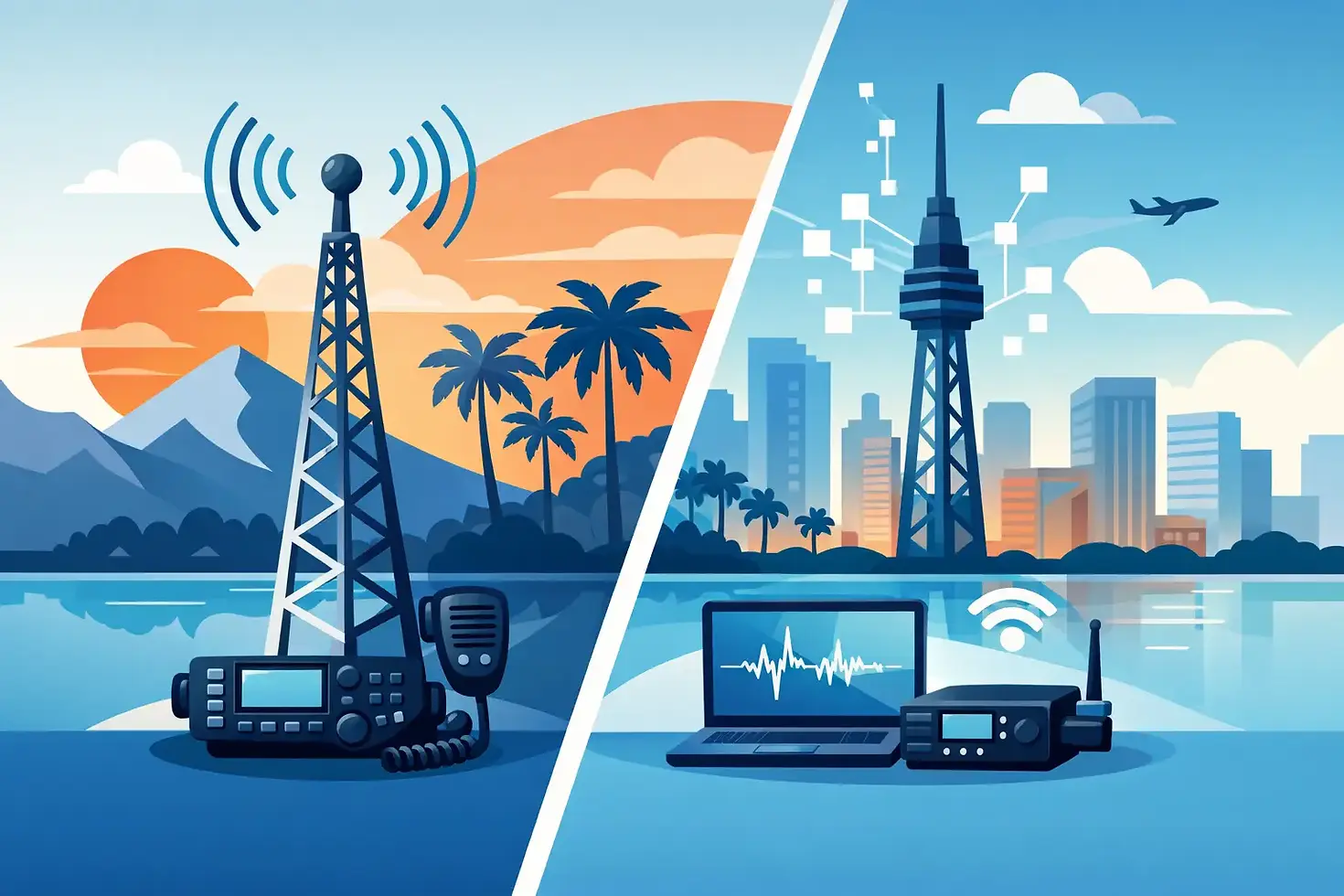
Analog Repeater vs VARA FM for Miami Operators

An analog repeater and a VARA FM node can both extend the usefulness of a local radio network, but they serve very different operating needs. For Miami-area operators comparing analog repeater vs VARA FM, the practical question is not which mode is better. It is which system matches the traffic you need to move, the equipment you have available, and the level of coordination your group expects.
An analog repeater is built for immediate voice communication. VARA FM is built for moving data efficiently over an FM radio channel. A well-organized radio community benefits from both because voice and data solve different problems during normal club activity, public-service operations, and preparedness planning.
What an Analog Repeater Does Best
An analog repeater receives a signal on one frequency and retransmits it on another. Its purpose is straightforward: improve coverage so operators using handheld, mobile, or base radios can communicate across a wider area than simplex normally allows.
For most operators, the repeater is the first point of contact. You monitor it during a commute, call for a signal report, check into a net, or join an informal QSO. The operating process is fast because it requires little more than a properly programmed radio, the correct offset, and the required access tone if one is used.
Voice is the repeater's advantage. When an operator needs to pass real-time information, coordinate a meeting point, report changing conditions, or simply ask whether anyone is on frequency, analog FM is hard to beat for speed and accessibility. A new member with a handheld can participate without a computer, sound-card interface, or specialized message software.
That simplicity also makes repeaters valuable during local coordination. A net control station can direct traffic, ask stations to stand by, and move detailed discussions off the primary channel. Operators can hear urgency in a caller's voice and clarify misunderstandings immediately.
The trade-off is that voice is not an efficient way to move detailed written information. A long list of names, an address, a damage report, or a set of deployment instructions must be copied manually. A missed call sign, number, or street name may require repeated transmissions. The repeater is excellent for conversation, but it does not automatically create a record of what was said.
What VARA FM Brings to a Radio Network
VARA FM is a software modem designed to transfer data over FM radio channels. Instead of speaking into a microphone, the operator uses a computer or compatible device connected to a transceiver. Depending on the system and application in use, VARA FM can support message exchange, forms, files, position data, and other digital traffic.
A VARA FM node is not a voice repeater with a different label. It is a digital access point. The user connects through radio equipment and software, then sends or receives structured information through the node. This approach can be especially useful when the message needs to arrive accurately and remain readable after the transmission ends.
For example, a volunteer group may need to distribute a written operating plan, submit a check-in form, or pass an inventory list. Sending that material by voice can consume airtime and introduce errors. With a properly configured VARA FM station, the same information can be transferred in a form that the receiving operator can review, save, and forward.
VARA FM also changes how operators think about channel use. A voice channel can support several people listening at once, with a net control station managing the conversation. Digital traffic is more session-oriented. One station connects, traffic moves, and the channel is occupied for that exchange. The operational discipline is different, particularly on a shared local frequency.
Analog Repeater vs VARA FM: The Real Decision
The most useful comparison is based on the type of traffic, not on technology preference. Choose an analog repeater when the priority is live voice coordination. Choose VARA FM when the priority is accurate, structured, and repeatable data transfer.
An analog repeater is usually the better choice for a weekly net, casual check-ins, event coordination, weather observations, welfare traffic, and situations where several operators need common situational awareness. It supports the social side of radio as well as the operational side. People hear one another, learn local operating practices, and become familiar with the voices behind the call signs.
VARA FM is better suited to traffic that should not rely on someone writing it down correctly. That includes forms, digital messages, logs, maps or files where supported, and detailed instructions. It can reduce voice-channel congestion when a group needs to move more than short verbal updates.
Neither system replaces the other. A practical operating plan may use the analog repeater for initial contact and tactical coordination, then direct stations to the VARA FM node for documents or detailed status reports. Voice tells the group what is happening now. Digital traffic preserves what must be acted on later.
Equipment and Setup Differences
The entry path for analog repeater use is relatively simple. An operator needs an appropriately licensed radio service, a radio capable of the required band and mode, antenna coverage adequate for the area, and correct repeater programming. A handheld may be enough for nearby access, while mobile and base stations generally provide better reliability in challenging locations.
VARA FM requires more preparation. In addition to the radio and antenna system, operators need a computing device, compatible interface or audio connection, correctly configured software, and an understanding of the node's operating method. Audio levels, push-to-talk control, COM ports, and frequency accuracy all matter. A station that works well for voice may still need adjustment before it reliably passes digital traffic.
This is not a reason to avoid VARA FM. It is a reason to test before an operational event. Build the station at home, confirm that transmit and receive audio are clean, make a successful connection, and practice sending the types of messages your group may actually use. Digital preparedness is not having software installed. It is having a station that has been tested by the operator who will use it.
Coverage, Capacity, and Local Conditions
Miami-area radio operation has its own considerations. Dense development, building materials, mobile traffic, and varying antenna environments can all affect FM coverage. A repeater at a favorable site may offer dependable access where simplex is limited, but an operator should still understand their own station's capabilities from home, mobile, and common activity locations.
VARA FM depends on RF quality too. Digital modes can provide useful performance under conditions where a message is difficult to copy by ear, but they are not magic. Weak signals, incorrect audio settings, interference, and overloaded shared channels can affect transfers. A successful digital path should be measured through regular use, not assumed from a coverage map or a single test.
Capacity is another distinction. A repeater supports a broad listening audience, although only one station should transmit at a time. A VARA FM node can efficiently handle a defined exchange, but operators need procedures that prevent unnecessary connections or unplanned traffic during priority use. When several people need information at once, a brief voice announcement may still be the fastest way to direct everyone.
Building a Better Operating Plan
For an organized club, the strongest approach is to assign each system a clear role. The repeater can serve as the primary voice resource for nets, announcements, on-air participation, and initial incident coordination. The VARA FM node can support written traffic, forms, and training exercises that help members build digital operating confidence.
Unified Radio Group Inc. members can gain more from the infrastructure when they practice both paths during ordinary activity. Call into the repeater. Learn how to check in efficiently. Then set up a digital station and send a test message during a scheduled session. Familiarity developed during routine use is more valuable than trying to configure equipment under pressure.
Operators should also keep procedures simple. Identify the voice frequency or repeater that serves as the calling resource, define when digital traffic should move to VARA FM, and establish who is responsible for monitoring each service during an organized event. A short plan that members understand will outperform a complex plan that sits unread.
The best choice is often not analog repeater or VARA FM. It is a prepared operator who knows when to use voice, when to send data, and how to move between both without delaying the people counting on the network.


Comments